



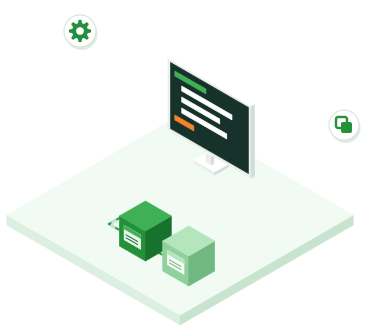
API and Terraform: a code file that creates servers in the cloud

A REST API, the same as the portal's

The portal, the command line and the AI assistant all use the same REST API, described in OpenAPI. Nothing is reserved for the web interface: whatever you do in a few clicks, you can script.

Each organisation creates its application credentials in the portal and can revoke them at any time. Their role limits what a script can do, and the token is shown only once, when it is created.

Terraform and OpenTofu

The PYSOFT provider describes your VMs, security groups, public IPs and load balancers as code: you version your infrastructure, review it before applying it and recreate it identically.

Existing resources can be imported. A flavour change is made in place, and the VM restarts. Volumes, VPNs, Kubernetes and S3 storage will come next.

Security and limits

Calls go over HTTPS, and every token is verified by the platform itself. Each identity is limited to 20 requests per second, with a reserve of 100, so that a runaway script bothers no one.
API and Terraform

At a glance

OpenAPI REST API

Every function of the portal.

Application credentials

Per organisation, with a limited role, revocable.

Terraform and OpenTofu

VMs, security groups, public IPs, load balancers.

Import what exists

Your current resources move under Terraform.

Command line

The same access from your terminal.

20 requests per second

Per identity, with a reserve of 100.

Process

How it works

Step 1

Create an application credential

On your organisation's page, in the portal.

Step 2

Configure the provider

API address, token and default organisation.

Step 3

Apply your plan

terraform plan, then terraform apply.

Frequently asked questions

Good to know

VMs, security groups, public IPs and load balancers. Volumes, VPNs, Kubernetes clusters and S3 buckets will come next; in the meantime, they are managed through the API or the portal.

OpenTofu is the open-source version of Terraform, run by the Linux Foundation. The PYSOFT provider works with both.

Give its application credential the lowest role that is enough: read-only for an inventory, administrator to create VMs. A credential never gets a role higher than that of the person who creates it, and can be revoked in one click.
PYSOFT Cloud

The other services in your VDC

How the PYSOFT cloud works

The PYSOFT cloud combines proven building blocks (OpenBSD, KVM, etcd, pf, relayd) around simple, auditable code. The goal: to offer …

Your virtual data center (VDC) in Algeria

A VDC brings your entire infrastructure together in an isolated space: servers, networks, firewall, VPN, storage and load balancers. You …

Virtual servers hosted in Algeria

Virtual servers hosted in Dellys and billed in dinars: choose a predefined configuration or build your VM by the vCPU, …

Encrypted VMs, from disk to memory

Encrypt each VM's disk with AES-256 using a key unique to that VM, and its memory with the AMD processor. …

Appstore: your applications ready in minutes

Choose an application and a VM size: the platform takes care of the rest, from installation to HTTPS, including the …

Autoscaling: your servers follow the load

An instance group adds VMs when the load goes up and removes them when it goes back down. You pay …

Routed SDN network: private networks and public IPs

Each organization has its own network, isolated from the others at the routing level. Your VMs communicate with each other …

Firewall as a Service (FWaaS) based on pf

Every VM has its own firewall, applied on its interface by pf, OpenBSD's firewall. You get the fine-grained control of …