




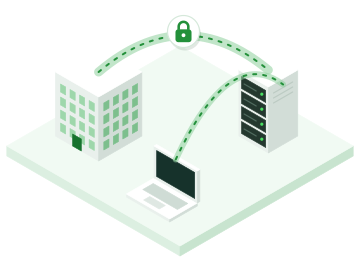
Encrypted VPN tunnels between an office, a laptop and the cloud

Two types of VPN

The IPsec (IKEv2) VPN connects a site, for example the router at your head office, to your private network: it is the standard for enterprise network equipment. The WireGuard VPN, which is simpler, is also suited to remote access: laptops and phones.

Site-to-site IPsec VPN

Each connection describes the remote site (its public address and identity) and the networks to connect on each side. The service is built on iked, OpenBSD's IKEv2 implementation; authentication uses a pre-shared key.

WireGuard for remote users

WireGuard, built into the OpenBSD kernel, creates encrypted tunnels with short keys, without complex negotiation. You add one peer per device, and its private key can stay on the device.

Always available

The VPN service runs on one of the platform's servers. If that server goes down, the service restarts on another server and the tunnels are re-established.
VPN

At a glance

Site-to-site IPsec

IKEv2, compatible with enterprise routers.

WireGuard for remote users

Laptops and phones, one peer per device.

Your private networks

Your organization's networks, reachable through the tunnel.

Keys under your control

The WireGuard private key can stay on the device.

Failover

The service restarts on another server in the event of a failure.

Created in one sentence

The AI assistant prepares the service and its connections.

Frequently asked questions

Good to know

IPsec (IKEv2) is the standard for enterprise routers and firewalls: it is suited to connecting an entire site. WireGuard is simpler and lighter: it is also suited to your team members' laptops and phones.

Yes, if it supports IPsec with IKEv2, which is the case for most enterprise routers and firewalls. You declare its public address and the networks to connect.

The VPN is billed according to the connections and peers used: contact us for a quote.
PYSOFT Cloud

The other services in your VDC

How the PYSOFT cloud works

The PYSOFT cloud combines proven building blocks (OpenBSD, KVM, etcd, pf, relayd) around simple, auditable code. The goal: to offer …

Your virtual data center (VDC) in Algeria

A VDC brings your entire infrastructure together in an isolated space: servers, networks, firewall, VPN, storage and load balancers. You …

Virtual servers hosted in Algeria

Virtual servers hosted in Dellys and billed in dinars: choose a predefined configuration or build your VM by the vCPU, …

Encrypted VMs, from disk to memory

Encrypt each VM's disk with AES-256 using a key unique to that VM, and its memory with the AMD processor. …

Appstore: your applications ready in minutes

Choose an application and a VM size: the platform takes care of the rest, from installation to HTTPS, including the …

Autoscaling: your servers follow the load

An instance group adds VMs when the load goes up and removes them when it goes back down. You pay …

Routed SDN network: private networks and public IPs

Each organization has its own network, isolated from the others at the routing level. Your VMs communicate with each other …

Firewall as a Service (FWaaS) based on pf

Every VM has its own firewall, applied on its interface by pf, OpenBSD's firewall. You get the fine-grained control of …