



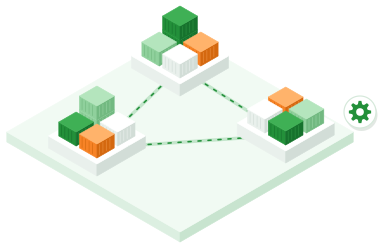
Kubernetes cluster: three nodes running containers

What is Kubernetes?

Kubernetes is the leading open source platform for running containerized applications. It spreads containers across several servers (the nodes), restarts them in case of failure and adjusts the number of replicas to the load.

Self-service Kubernetes

The service is built on Cluster API, the standard Kubernetes way of managing clusters. You choose the version, the flavors and the number of nodes (1 or 3 control plane nodes); the platform creates the VMs, installs Kubernetes and gives you the kubeconfig file. In our tests, a cluster is ready in less than 5 minutes.

Scaling and version upgrades

Add or remove workers at any time, from the portal, the API or the AI assistant, and upgrade the cluster to any of the available templates.

Container registry

Your container images are stored in the platform's registry, in a repository dedicated to your organization, and your clusters pull them without going through the Internet.

Expert support

Our engineers can also design the architecture of your applications and help you move them to Kubernetes, on a quote basis.

Kubernetes as a Service

At a glance

Self-service

A cluster ready in minutes.

Nodes to suit your needs

1 or 3 control plane nodes, workers on demand.

Version upgrades

Switch between the available version templates.

Container registry

Your OCI images, per organization.

Load balancer

Expose your services behind a load balancer, from 3,780.00 DZD excl. VAT.

AI-driven

"Add two workers": the assistant prepares, you confirm.

Costed example

Example: a production cluster

  • 3 × m1.large4 vCPU · 8 GB RAM · 80 GB SSD 25,434.00 DZD
  • Public IPs (EIP)1 IP 750.00 DZD
  • 1 × Load balancer Small 15,000 max. connections 3,780.00 DZD

Total29,964.00 DZD excl. VAT/month

or 35,657.16 DZD incl. VAT/month

Three nodes with 4 vCPUs and 8 GB of RAM, a public IP and a load balancer: a solid foundation for hosting several containerized applications.

Adjust in the simulator
Process

How it works

Step 1

Choose

Kubernetes version, flavors, number of nodes.

Step 2

The platform deploys

VMs, Kubernetes installation, kubeconfig provided.

Step 3

Deploy

Your applications with kubectl, Helm or your usual tools.

Frequently asked questions

Good to know

Yes, in self-service: you create a cluster from the portal, the API or the AI assistant, and the platform deploys it in VMs belonging to your organization. Our engineers can also support you, on a quote basis.

A service that creates and manages Kubernetes clusters for you. At PYSOFT, it is built on Cluster API: you choose the version and the nodes, the platform creates the VMs, installs Kubernetes and gives you the kubeconfig.

The nodes are VMs billed at the public rate: for example 8,478.00 DZD excl. VAT per month per m1.large node, plus 3,780.00 DZD excl. VAT for a Small 1 load balancer. Any expert support is quoted separately.
PYSOFT Cloud

The other services in your VDC

How the PYSOFT cloud works

The PYSOFT cloud combines proven building blocks (OpenBSD, KVM, etcd, pf, relayd) around simple, auditable code. The goal: to offer …

Your virtual data center (VDC) in Algeria

A VDC brings your entire infrastructure together in an isolated space: servers, networks, firewall, VPN, storage and load balancers. You …

Virtual servers hosted in Algeria

Virtual servers hosted in Dellys and billed in dinars: choose a predefined configuration or build your VM by the vCPU, …

Encrypted VMs, from disk to memory

Encrypt each VM's disk with AES-256 using a key unique to that VM, and its memory with the AMD processor. …

Appstore: your applications ready in minutes

Choose an application and a VM size: the platform takes care of the rest, from installation to HTTPS, including the …

Autoscaling: your servers follow the load

An instance group adds VMs when the load goes up and removes them when it goes back down. You pay …

Routed SDN network: private networks and public IPs

Each organization has its own network, isolated from the others at the routing level. Your VMs communicate with each other …

Firewall as a Service (FWaaS) based on pf

Every VM has its own firewall, applied on its interface by pf, OpenBSD's firewall. You get the fine-grained control of …